Introducing Zillij: The Islamic Geometry Studio I Couldn't Buy, So I Built It
Public beta now open: https://fredini.linearlife.com/zillij/
I didn't use AI to make art. I used it to build the tool to make art with.
You can now construct a precise and complex Islamic geometric pattern in your browser, in minutes, and export it as clean vector art ready for print, laser cutting, or importing into 3D CAD software. That is not how composing these patterns has ever gone before.
I've been interested in sacred geometry for quite some time, but I have always found Islamic patterning to be daunting and confusing. It's always begun the same way it has for a thousand years: pencil, paper, compass, and straightedge. Anyone who has constructed them by hand knows the truth of it. Most of the hours go not into the design, but into the repetition. You draw construction lines just to divide a circle into equal parts. You connect intersection points with line after line to build symmetries, constantly getting confused about which points are supposed to connect to which. It is slow, it is finicky, and a single mistake can cost you the whole sheet. This process also impedes experimentation and innovation.
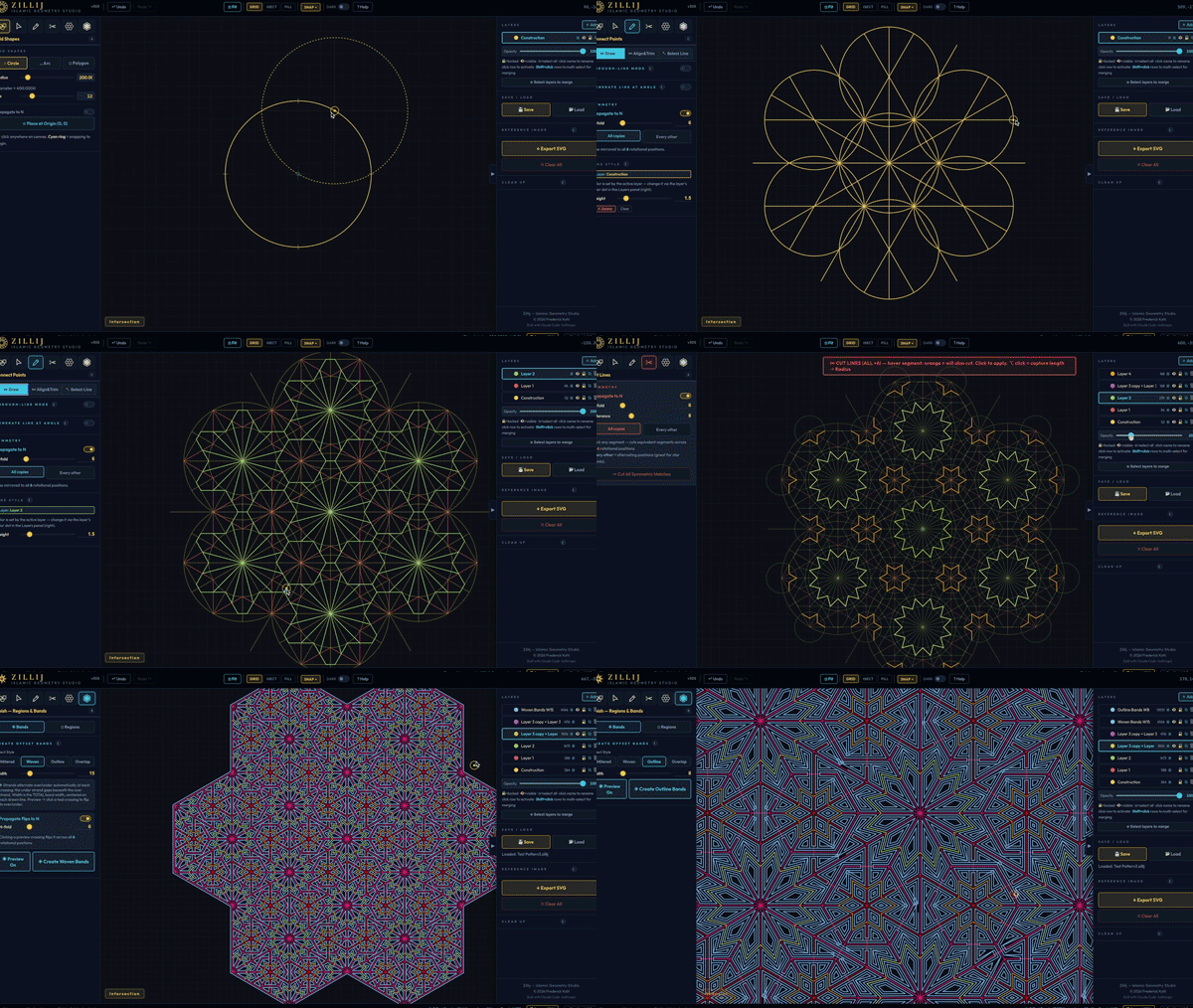
An example of creating a pattern using Zillij. Based on a Persian Orosi Glass pattern Taught by Samira Mian on YouTube.
Where Zillij came from
Zillij began as a personal problem. I wanted to design glass castings and sculptures inspired by muqarnas, the intricate 3D honeycomb vaulting found in Islamic architecture, and I needed a way to construct precise geometric vector art that could be imported into 3D modeling software and extrapolated into three dimensions. Nothing out there did exactly what I needed. Vector tools like Adobe Illustrator either weren't accurate enough with their snapping, or they made placing lines in symmetry so laborious that the work stopped being fun. So this past March, I started building the tool I needed to make the work I wanted to make. Today I'm releasing it as a capable, working tool for the world to play with, as it enters public beta.
It's also worth noting that my own work aims not to be derivative and culturally appropriative. I want to use Islamic patterning and muqarnas as a starting-off point for creating tesselated surfaces. As I understand it, the remarkable thing about Islamic geometry is that it grew out of a tradition of not depicting God, and instead invoking the awe of the everything through its immense complexity. My own work aims to invoke these feelings in a voice that's truly my own.
What makes Zillij different from the handful of geometry apps already out there is that I didn't build it as a toy or a novelty. I built it as a production tool for a working artist who needs the output to be accurate enough to fabricate. Precision isn't a feature here. It's the whole point.

My inspiration: Decorative muqarnas vaulting in the iwan entrance of Fatima Masumeh Shrine in atabki sahn, Qom, Iran. Photo by Amir Pashaei courtesy of Wikimedia Commons
Who this is for
If you're a geometer or a student of Islamic pattern, Zillij will save you the hours you currently spend on repetition. If you're an artist, a designer, an architect, a quilter, a fabric designer, a tile maker, or anyone who works with pattern, it will hand you clean vector art you can take straight into your own workflow. And if you're just curious what happens when a thousand-year-old craft meets modern tools, you can open it right now and start playing. No installation, no account, no subscription.
AI as a tool, not a shortcut
I want to say something about AI here, because I know how loaded that subject has become. Right now my Instagram feed, and probably yours, is clogged with generative AI images and video. Endless slop, synthetic pictures, and half the time you genuinely can't tell what's real anymore. I understand the backlash. When AI gets used to flood the world with fake imagery, and to do people's writing and thinking for them, it cheapens things, and that should make us uneasy.
But that is not the only story about AI, and it is not the story of Zillij. I didn't use AI to fake a picture of a pattern that never got made. I used it to build a real tool that didn't exist, one I actually needed, so that I could make real things with my own eye and my own hands. The geometry is exact. The output is true vector art. The glass, when I get there, will be real glass. AI here isn't replacing the craft, and it isn't replacing me. It's a power tool in the workshop, and I'm still the one holding it, making every decision about what gets built and why. To me that's the far more interesting and hopeful version of this technology. Not generating counterfeit reality, but handing an individual maker the ability to build the specific tools they need to do work that is entirely their own. That's the example I want to set with Zillij.
Working with Claude AI
I'm not a good programmer, and I could never have built Zillij alone. I built it in partnership with Claude Code, and the way we work together is much like the way I used to work as a creative director with a developer, just far faster, and without the budget constraints and the emotional pushback that come with a human team. There have certainly been times I'm frustrated with its failures, where I have to mercilessly bug test and document unexpected behaviors until it gets things right. But the caliber of what I've been able to create has surpassed some of the most ambitious things I made during my years as a creative director. Overall, it has been an immensely satisfying experience.
The whole time I've been building it, I've been studying the complexity of Islamic patterning. I am only beginning to understand the geometric constructions, the symmetries, and the logic that governs how something like an 8-fold rosette resolves against a 12-point star, or even more complexities like 9’s and 11’s. I've watched countless tutorials, interviewed geometers, and backed the Patreons of some fabulous teachers. Through that research I learned enough to write an initial brief for the tool I wanted: it had to generate circles and shapes, draw construction lines, support layering and grouping, and above all export SVG vector art. Then, through hundreds of iterations, a real application started to emerge. Every new layer of complexity pushed me toward a more streamlined interface and, strangely, more capable features. Code reviews and testing scenarios brought greater efficiencies. I bring the vision and the intention. Claude brings the ability to turn that intent into working software, fast, and to iterate with me in real time. I describe how a feature should behave. We build it, I test it against real patterns, I find where it breaks, and we refine. A feature that might once have taken months with a dev team now takes an afternoon of back and forth. It really is like sitting at the drawing table with a collaborator.
What I've learned building this way
A few things have surprised me. The first is that being a non-programmer stopped being the barrier it used to be. What mattered far more was visualizing the end product and being able to describe it, test the output, and refuse to accept "close enough." The second is that the hard part was never the code. It was understanding the geometry deeply enough to be able to build tools that could create them. The tool is only as good as my grasp of the craft, and building Zillij has made me a better student of the craft in turn. The third is that this collapses the old distance between having an idea and holding the thing itself. For a maker, that is enormous, and I don't think most people have felt the full weight of it yet.
What Zillij does
Zillij runs entirely in your browser. It automates the repetitive labor while keeping you in full control of the design:
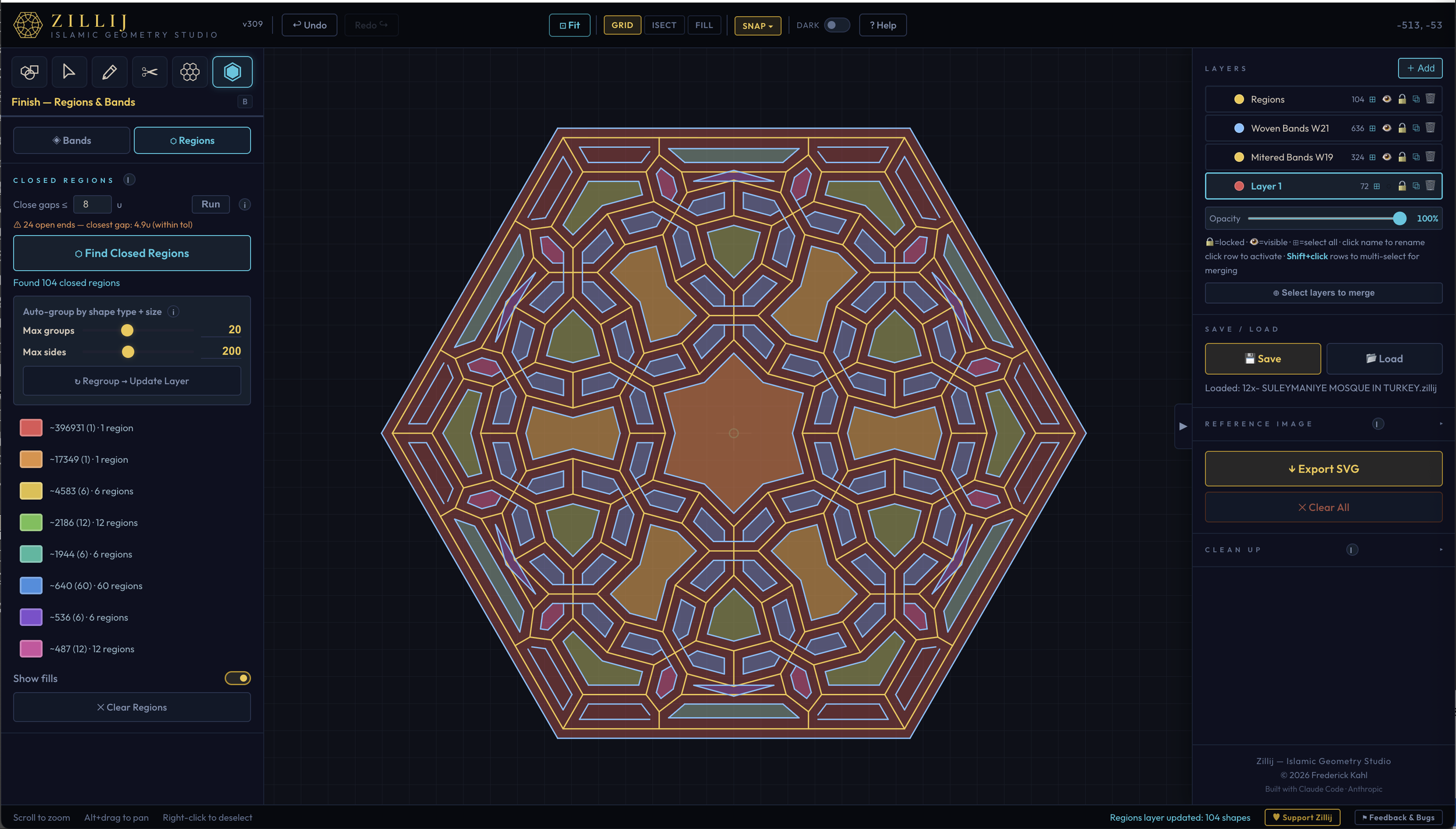
Zillij is a browser based tool for creating Islamic geometry patterns as vector art.
Precise shapes and snapping: place circles, polygons, and arcs to build the framework and construction lines every pattern is built upon.
Connect and cut: draw connecting lines between intersection points, then cut away what isn't needed and trim down to the finished pattern.
Symmetry: apply N-fold radial symmetry, mirror, and tessellate a single motif across a whole field.
Tiling: repeat a square, hexagon, rhombus, or triangular tile to fill a patterned field.
Banding: convert simple line art into woven, mitered, or outlined bands.
Color and layers: detect closed regions and fill them with color, and organize everything into layer groups with full undo history.
Clean vector export: output true SVG, not a flattened image.
That last feature matters more than it might sound. Because Zillij exports real vector artwork, your pattern flows straight into the tools you already use: Adobe Illustrator for print and design, Rhino for taking a pattern into three dimensions, or a laser cutter for physical fabrication.
Where this is going
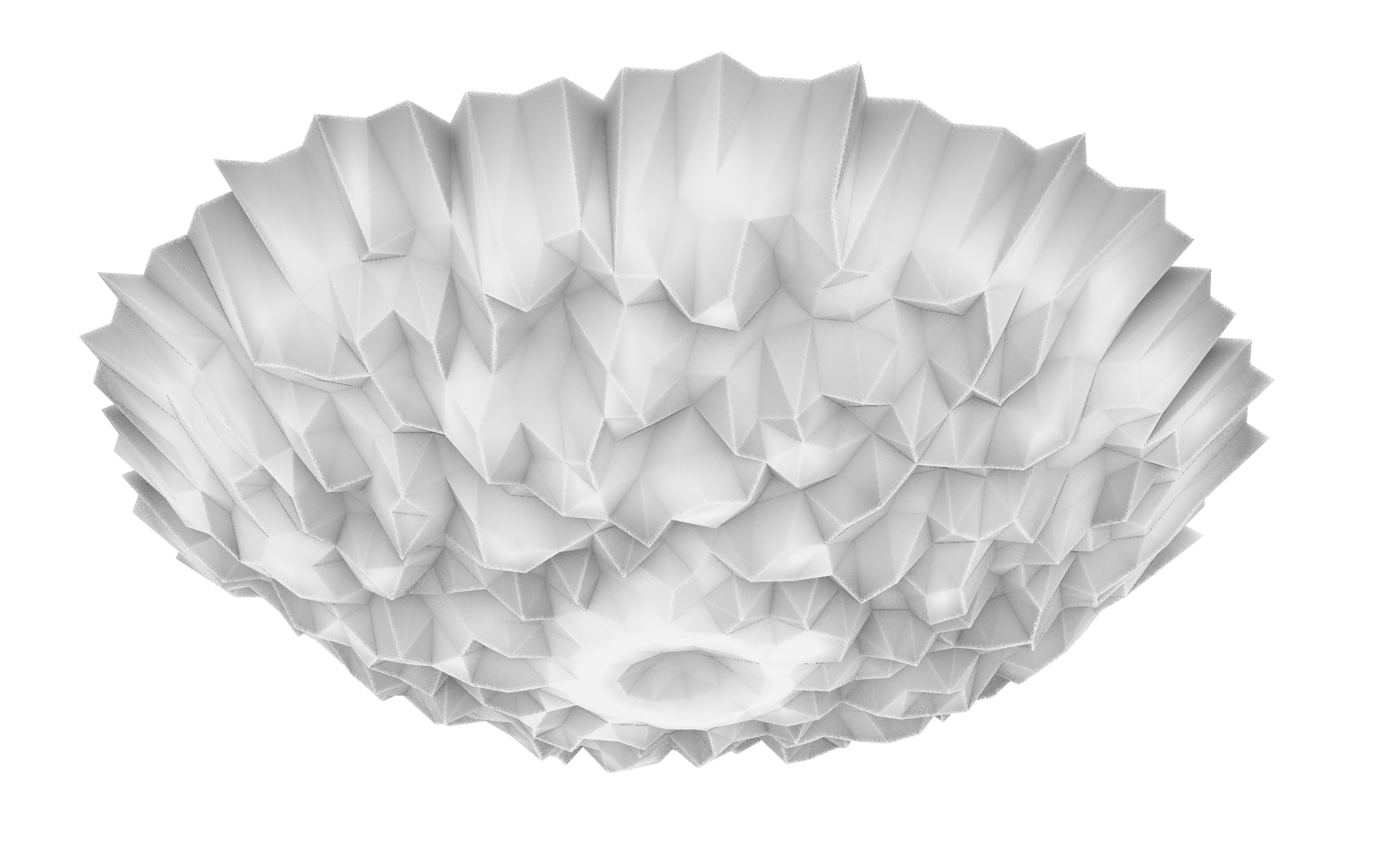
An in-development design for a centrifugally cast glass bowl based on a Penrose tileset.
For me, the flat pattern is only the beginning. I'm using this tool to output 2D art that will be used to create 3D designs for custom glass casting molds — turning centuries-old geometry into physical, fabricated objects. Zillij is the first public piece of that larger effort, and I'll keep sharing the process as both a maker and a teacher. More on this 3D work soon.
See it in action
I've just finished a series of four videos walking through how Zillij works, from first circle to finished export:
Try the beta
Zillij is open for public beta right now at fredini.linearlife.com/zillij. Whether you're a geometer, a designer, an architect, a pattern maker, a quilter, or just curious, I'd love for you to try it and tell me what you'd want it to do next. This is a beta in the real sense. It grows from your feedback, and the roadmap already includes a component library, line weaving, and more.
And if you make something with it, please show me. I want to see what you build, and I want this to become a place where makers share what's possible. You can follow the 3D and glass work, and more of my art, at thegreatfredini.com.